
https://medium.com/@paulemcmahon/human-resilience-understanding-the-power-of-purpose-f2176f9691e4
Human Resilience: Keep Running Your Life
There is a long story behind my latest book, “Human Resilience: Keep Running Your Life.” To get the short quick version listen to the following 50 second video book trailer. If you want a little more information about the book, below the video trailer are a few links to clips from the audible version of the book.
Click below to listen to a 90 second clip from the audible version of the book on the background and purpose.
For those interested in digging a little deeper into the thinking behind the book and learning about how I used modeling and my personal running data to help me become a more resilient runner listen to the following roughly 5 minute clip from the audible version.
The ebook, paperback, and hardcover version of the book will be available for purchase on Amazon.com starting December 15, 2024. Click the following link to learn more:
You can purchase the Audible version of the book now, and you can get a free sample of the first 5 minutes of the Audible version of the book (click on preview) at the following link:
My wife turns to me and says…

My wife turns to me and says, “The world has gone crazy. Why can’t people just let other people live.” So, I turn to her and say, “This isn’t new. It’s gone on forever. I’ve thought a lot about it and believe it or not, I finally figured out why.”
Now I’ve got her attention. I know at this point my answer better be good. She’s looking right at me.
I continue, “You see, it all started when we were very young and our parents told us the story about this wonderful world we all live in and why we are here, as if they knew why we are here. But they don’t. It’s just a story they made up so kids wouldn’t be scared by the truth.”
She is still looking right at me, so I continue.
“And the truth is– the thing nobody wants to talk about even after they grow up– the real elephant in the room every moment of everyone’s life—is the fact that none of us know why the hell we are here. So, we grow up, and gradually figure out the truth and then we run around with this feeling all bottled up inside until one moment when we’re sitting in a crowd somewhere and without realizing it we get up and walk across the room and slap someone who doesn’t deserve it. Or, if we happen to have a little power, we invade our neighbor’s country. The fact is we don’t know what we are doing, and either we are going to kill some one or not.”
Now, at this point I have my wife laughing. So that’s a good thing.
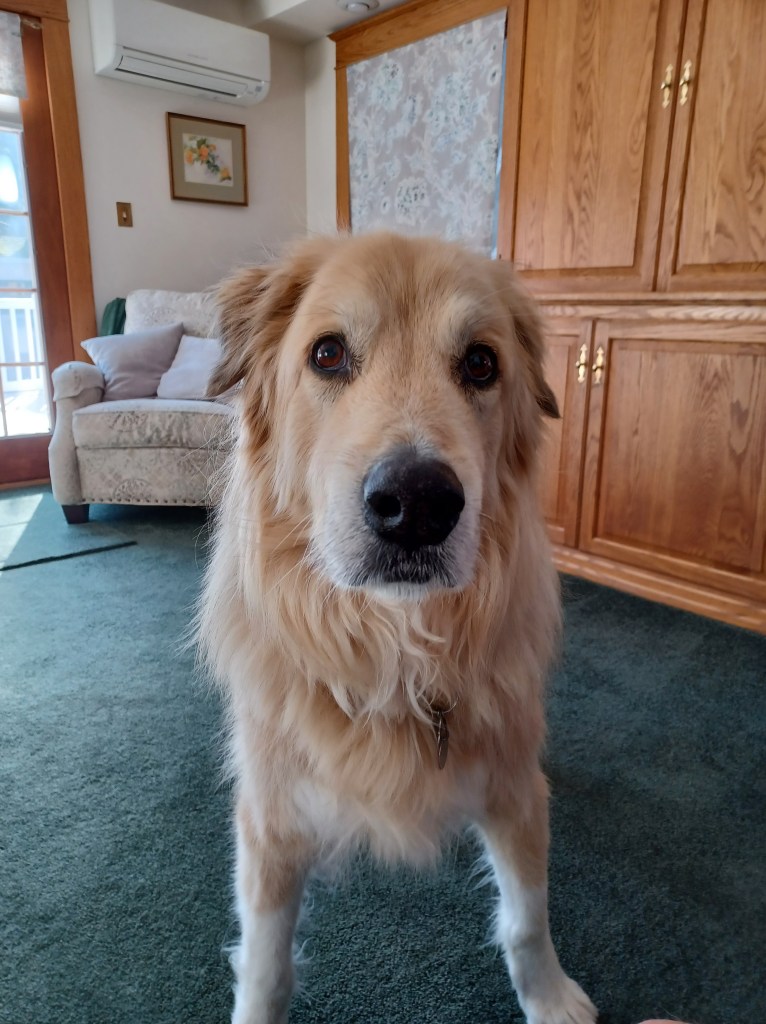
Later I come downstairs and she’s talking to the dog. She tells the dog, “I know you are upset because we left you down here all alone for too long.” You see, our dog who is twelve years old has never been able to kick his separation anxiety. When we leave him alone for more than an hour he starts to drool over everything in the house. Or he tips over the garbage can and spreads the garbage all through the house. I look at my wife as she comforts the dog and think to myself, “the dog doesn’t know why he is here either.”
So, what should we do? I’ve heard that figuring out the root of a problem is half-way to the solution. I found an 8-minute video on the internet by Elon Musk and sent it to my kids and wife. In the video Musk says, “Life can’t be just about solving problems. There has to be things people find inspiring that make life worth living.”
Musk also says in the video you have to work super hard, like 100 hours a week. My daughter replied that she found the video thought provoking and inspiring and it made her smile. I expected that because she works 100 hours a week like me. My son replied saying Elon has some pretty revolutionary ideas for the next few decades and that it should be an interesting ride if he hits his goals.
So, what’s the answer? I wish I could tell you that. But if I did you probably would think it’s just another story like the one your parents told you. You have to figure out the answer for yourself. Musk ends his talk by telling a graduating class that now is the time to take risks, and do something bold because it’s going to get tougher when you get older.
I don’t know about that. The older I get the bolder I get. But I hope I don’t get to the point where I find myself slapping someone across the face whether they deserve it or not. But you better watch out for us old people. We don’t have as much to lose.
My alter ego just published a new book
My alter ego, Paul E. McMahon, has been involved for the past ten years in an initiative to change the world of software engineering. You can learn more about it in the following short video motivating his latest book.
On thinking better
What does it mean to think better? When I first began my career as a software developer at a company in upstate New York way back in 1973, my first greybeard mentor gave me some advice. He told me to learn the things that never change because it will give me more time to spend on the new and interesting things when they come along. That advice stuck with me.
When you think about how much things have changed in the last 50 years with advances in technology and medical research it’s easy to start feeling like what you learned when you were young is completely outdated. But that isn’t necessarily so.
In my “Quiet Little Town” story, Fred is working on a secret research project aimed at helping kids think better and make better decisions by placing them in a virtual world where they face difficult, but common life situations.
Today, many high-tech companies are spending hundred’s of millions of dollars on an idea known as the Internet of Things (IOT). IOT is the modern world of interconnected humans and software-controlled devices intended, along with artificial intelligence, to make our lives easier in the future by helping us solve common everyday problems.
So, a natural question this leads to is: Will these huge investments in technology and medical research help our future kids think better and ultimately achieve the goal of Fred’s secret project?
Well, as usual, I don’t want to give away what happens in my “Quiet Little Town” story, but let me share a true story that might give you a hint.
In his bestselling book, “Zero to One”, Peter Theil co-founder of PayPal, tells the story of one of Google’s supercomputers that received great reviews back in 2012 when it was able to recognize a cat with 75% accuracy when scanning millions of Youtube videos. Peter tells us in his book that this technological advance sounds impressive until you step back and think about the fact that a four-year old can do it flawlessly 100% of the time.
The point is that today’s faster computers and artificial intelligence are great at finding patterns in large masses of data, but they can’t hold a candle to a human when it comes to drawing insights from patterns and the ability to think.
The most valuable lesson my old greybeard mentor taught me almost 50 years ago didn’t have anything to do with computer technology or artificial intelligence. It was how to use my natural human ability to think about a problem in a logical way leading to an innovative solution given a challenging situation.
Perhaps, one of the best things we can teach our kids today is how to use their natural human ability to think critically in common everyday situations.
How to think critically when faced with today’s common everyday challenges is no different than it was 50 years ago, and probably will not be any different 50 years from now. Thinking critically is how you think better, and it is one of those gifts you can take with you for a lifetime.
 Problem Solving in a Cyber World