
In my recently published book, “Human Resilience: Keep Running Your Life” (https://rb.gy/is0s1z ), I share many stories of challenges faced and I highlight 35 life lessons that helped me throughout my life. When the book was released in December, 2024 I had not yet achieved my goal of running 70 half marathons after reaching the age of 70. This story is a somewhat lighthearted look at the trouble I ran into between my 69th and 70th half marathon after reaching 70 years old and it highlights 3 of my 35 life lessons that are too often overlooked:
Life Lesson #5: Each human, along with their experiences, is unique
Life Lesson #10: Pain is a signal, the cause may not be where it hurts
Life Lesson #27: Living a resilient life is not an exact science
Background
On May 17, 2025 I ran my 70th half marathon after reaching 70 years old. This was a goal I set for myself a few years after running into multiple health set-backs between the ages of 67 and 70. After completing my 69th half at the Winter Soldier Half Marathon in Cape Vincent, New York, on February 22, 2025, I started wondering if I would still have the motivation to keep running after achieving this goal. This is the story of what happened between my 69th and 70th half marathon and how it motivated me to keep running as long as I can.
Introduction
On Saturday, March 8, 2025 I ran the Saint Patrick’s Day 4 mile race in my hometown. As I walked away from the finish line I felt a sharp pain in my right knee. At the time, I didn’t think much of it since I had run hard down the final stretch and thought it would clear up on its own within a day or two.
Over the next week I iced it every night. Looking back over my notes, I realized it was time to order new running shoes. On the following Friday, March 14, after driving my wife to the airport for a trip, I felt a throbbing ache in my right shin just below the knee. Since the knee pain hadn’t cleared up, when I got home I called my Primary Care Physician (PCP) to get an order for an x-ray to ensure I didn’t have a stress fracture.
The next day I got the x-ray and was relieved to learn there was no stress fracture, but I still didn’t have a good explanation for my knee pain. I have always tried to keep an open mind when it comes to my running performance and health.
The fact is I am 76 years old and have been a competitive runner for over 45 years. I also noticed that I was feeling achy in multiple places around the knee, not just on the knee itself. Whenever this happens I do the usual things most runners do including icing, stretching, foam roller massaging, hydrating, cupping, and checking to see if it is time to order new running shoes.
Cupping is an approach I have been using to relieve aches and pains after hard runs for many years, but today I am noticing some unusually dark red spots all around the knee when cupping. On the internet I find the following information:
These dark red marks suggest that the body is actively dealing with stress or tension in that area…. Bright red marks appear when the therapy helps to quickly restore blood flow to an area where it was previously restricted
The Concern for Possible Arthritis
Going back over my running notes (I have been keeping running notes for over 40 years), I vaguely recall dealing with a similar incident sometime in my distant past. Is this a recurrence of an old injury? I wonder to myself. Or could this be something completely new? I am only weeks away from turning 76 years old at the time and I like to be realistic about these things. The thought of arthritis briefly enters my mind, but I quickly dismiss it, not wanting to go there.
Nevertheless, I decide to request an order from my PCP to see my Physical Therapist (PT) and on Tuesday, March 18 after explaining my symptoms to my PT we begin a weekly program that includes foam roller massaging, stretching and knee strengthening exercises.
A week later at my Wednesday afternoon session when I try to do the deep knee squat exercises the pain in my right knee seems to have gotten significantly worse. I am now experiencing stabbing pains not only in the knee, but also emanating down my right leg with tingling and numbness into my right toes. My PT suggests that I try a few different stretches and then asks me to get on the treadmill and run. When I get on the treadmill and run about a third of a mile the knee starts to lock up and then becomes extremely painful causing me to come to a full stop. My PT looks me directly in the eye and says,
“I am sorry to say this. I don’t say it often, but when was the last time you had an x-ray of that knee?”
I tell him I have never had my knee x-rayed, and then I ask, “What would we be looking for in an x-ray?” He replies with the word I don’t want to hear. “Arthritis.”
And then we have an honest discussion of the possible next options depending on what the upcoming x-ray indicates, including steroid injections, jell injections, or possible surgery. He recommends an orthopedic specialist about an hour north of where we live because they are using state of the art robotic-controlled minimally invasive surgery.
Getting My First X-ray of My Right Knee
I leave my physical therapy session and go straight to a walk-in 5 minutes from my home to see if I can get the knee x-rayed that same day. When I mention to the receptionist at the walk-in that the reason I want the x-ray is to check for arthritis, she looks at me and asks, “Is this from a new injury?”
I tell her It started after a race I ran 3 weeks ago and that I have never had it treated before. I apparently answered correctly because she approves the x-ray and I get right in. I am led straight to the x-ray room. After the knee is x-rayed I am led into another room where I wait a short time before a nurse comes in and starts asking me 100 questions and taking my blood pressure. I tell her my blood pressure will probably be high, but I do not have high blood pressure. It is 124/78.
Mindful Meditation
The reason my blood pressure is fine, I surmise, is because of my mindful meditation that I have been doing daily over the last few years. I took a moment sitting in the car in the parking lot just before entering the walk-in.
In the car I take a few slow and deep breaths. I remind myself what a great running life I have had up to that point in my life. I am 75 years old, within a few months of turning 76, and I have been running competitively for over 45 years. If someone had said to me 45 years before that moment that this moment would ever arrive, I would have taken it in a heartbeat regardless of what I am about to learn when I enter the walk-in in the next few moments.
Thinking Back to a Similar Incident
I also recall, in that moment sitting in my car, another time when I was about 30 years old and my first physical therapist was treating the same knee for a similar knee pain. At that time he called it a “plica syndrome” and gave me some exercises that I have continued to do over the last 45 years. A “plica syndrome” is a condition where the knee joint is inflamed. When I had gone to that PT for that issue I couldn’t run 3 miles without severe pain in the knee. Through a special set of exercises he devised just for me we strengthened the knee back to the point where I could run 5 miles without pain. I recall thinking at the time, if I can never run more than 5 miles I am good with that. I just wanted to keep running.
Getting the Diagnosis of My Right Knee and Initial Treatment
After the nurse leaves the room, a physicians assistant (PA) comes in and begins asking me a hundred and fifty questions. Then she says casually that she doesn’t see much arthritis– maybe a little along the bottom of the knee, but definitely not bone on bone.
That is a great relief to me. She prescribes a 6-day steroid pack and says if that doesn’t clear it up she will set up an appointment for about a month from now for me to see an orthopedic knee specialist at that same location.
Planning My Next Steps
I am not confident the steroid pack will solve the problem. I immediately start thinking about possible scenarios and what I might do next. I first send an email to a running friend who recently had knee surgery asking about his experience and if he would recommend his surgeon. He replies that he went out of town because it was going to take months just to get in to see a local orthopedic knee surgeon.
I am now thinking if the 6-day steroid pack doesn’t help, I don’t want to wait another month to figure out my next step. I text my PT and get the details of the out-of-town orthopedic specialist he had recommended. I call the number and get a recording to press different numbers depending on weather you are interested in hand & wrist, shoulder, foot & ankle, neck & back, or other. I press the number for other since I don’t specifically hear anything about knee.
I finally reach a human who starts asking me two hundred questions and as I answer them patiently one by one I am thinking I probably should have asked how long it is going to take to see an actual doctor because if it is going to take months I know I am going somewhere else. But after she finishes her questions she finally asks what doctor do I want to see? I tell her whatever knee specialist I can get in to see the fastest.
She then says, “How about Monday?” I reply, “You mean next Monday, as in 4 days from now?” She says, “Yes.” I quickly reply, “I will take it.”
I then ask her if she can get access to the x-ray of my knee in the system in my hometown. She says no, they will take another x-ray up here, or I can bring it. I hang up the phone, and immediately call my local walk-in 5 minutes from my home and they direct me to a location where I pick up a copy of the x-ray within the next hour.
Getting My Chiropractor’s Opinion
Later that same day I have a chiropractor appointment. I take my x-ray with me that I just picked up and after telling my story to my chiropractor he asks, “How long has it been since you got new orthotics?” It occurs to me he might be on to something and so we order my new orthotics.
I then ask my chiropractor if he would look at the x-ray of my knee and tell me what he thinks. He tries to bring it up on his computer, but it hangs up. He turns to me and asks what he should do because he thinks I am an IT specialist just because I know something about software. I tell him to power down and restart his computer, and he says he knew I would know what to do.
When he finally looks at my x-ray he agrees with the PA that my knee looks very good, especially for someone 75 years old that runs as much as I do. I tell him I am taking the x-ray to an orthopedic knee specialist about an hour north of our hometown on Monday. He tells me he bets the knee specialist will say I don’t need any surgery on that knee.
Back Pain for 50 years and a Doctors Surprising Recommendation
As we get talking about what the cause of the problem might be, I tell my chiropractor about a doctor who had treated me for back pain when I was in college close to 50 years ago. Back then 2-3 times a year I would end up in bed for 2-3 days having thrown my back out and feeling like it was too painful to even move.
That doctor told me I would most likely need back surgery to remove at least one disc that was being pinched by the other discs in my lower back. This was caused by a curvature of my spine. That doctor also said that my best chance to avoid surgery in the future was to take up a sport that would help keep the weight off my lower back. He even went so far as to say that while a lot of doctors wouldn’t recommend running, running was exactly the sport he did recommend because the benefits of running outweigh the risks.
My Chiropractor’s Response to the Surprising Recommendation
My chiropractor looks at me and says, “That is close to what I would recommend but not exactly. I would not have said running. I would have said anything else but running that helps to keep the weight off. But I don’t feel real good about telling you this because clearly you are proof he was right and that means I could be wrong, which I don’t like.”
Four Strategies to Solve My Knee Pain
Now I have 4 strategies to try to solve this problem– physical therapy, chiropractor, steroid pack and orthopedic knee surgeon. I am thinking even if I have a miracle cure from the steroid pack, I am still going to the knee surgeon an hour north on Monday because I don’t know what will happen when I increase my mileage again.
Thursday Night, March 27 — The Second Day of the Steroid Pack
I feel the steroids are kicking in. The ache in the top of the right knee seems less painful, especially when I try deep knee squats. I am almost starting to think this is a miracle cure. But then I remind myself I haven’t run more than half a mile in over 3 weeks and I shouldn’t get too optimistic just yet.
Friday, March 28 — Day Three of Steroids
My optimism fades when I decide to get on the treadmill and try to run. I end up just doing a fast walk for about three-quarters of a mile and then ice the knee. That afternoon I have a PT appointment and I take my knee x-ray with me.
I tell my PT everything that has happened since my last visit. He immediately knows what he wants to do. After about 15 minutes of electrical stimulation on my lower back and upper right leg, he reaches for a box of Rock tape and starts taping my knee. He then looks at me and says, “Do you want to get on the treadmill and try to run again?”
I wasn’t expecting that, but think, why not? I start out easy, then pick up the pace trying to get into a good running rhythm. This is where it usually starts to hurt. Soon the upper right corner of the knee starts to tighten and ache. I have only gone about two tenths of a mile, but I am now feeling like pushing this a bit through the pain. When I get to half a mile my PT says, “You are still going. Is that a good sign?”
If the Pain isn’t Worse, Run a Little Longer Through the Pain
The pain is still there, but it isn’t worse than it was at two tenths of a mile. I tell him yes and I keep going. I crank the treadmill speed up and keep pushing through the pain until I get to one full mile and then I stop. He asks why I stopped. I tell him that this is the first full mile I have run in 3 weeks and I don’t want to push it, but this is all a good sign.
At the same moment as I am telling him this, a memory from long ago flashes through my head. The memory is taking me back to the Marine Corp Marathon in 1988. Back then it was a pain that started in my groin at the 25-mile mark of the race. I didn’t think much of it then either, just like I didn’t think much of this one at the end of the Saint Patrick’s race. But when it didn’t get better for weeks after the race and weeks of physical therapy I went to see an orthopedic specialist who ordered an MRI of my hip. Before I knew it he was telling me I needed a hip replacement.
Refusing to accept this diagnosis at 39 years old I took my MRI to a specialist in Boston who looked at the image on his machine and said he didn’t know what was causing my pain, but told me to just go out and run until it hurts, and then the next day do it again. And then he said, “If it doesn’t hurt anymore the next day, run a little longer through the pain. Then just keep doing that.”
He then looked at me and said that one of two things would happen. Either I would get better, or I would really break something and if I broke something come back to see him because he would then be able to fix it. I followed that advice running through pain each day until one day I realized the pain was gone.
I look at my physical therapist as I got off the treadmill after finishing my first mile in three weeks and he says to me, “See you Monday.” Then he adds, knowing I am heading out of town to see the orthopedic knee specialist that he had recommended, “Its ok if you are a little late getting here.”
Monday, March, 31 — The Last Day of the 6-day Steroid Pack
It hasn’t solved the problem as I expected. I get up early and drive the hour north to the orthopedic knee specialist, with the x-ray of my knee in hand.
The receptionist thanks me for completing the on-line form and takes the disc from me with my x-ray reminding me to be sure to pick it up before I leave. As I am waiting to be called in, she calls me back and hands me the disc saying she has already downloaded it into their system.
Within a few minutes I am led into the office where after a short wait the knee specialist arrives. He tells me he has reviewed my x-ray. After asking a hundred questions and moving my right leg in 25 different directions, he asks me if I want the good news or the not so good news first. I opt for the good news.
Life Lesson #10: Pain is a signal, the cause may not be where it hurts
He looks me directly in the eye smiling and says, “Contrary to what you might have heard, all the running you have done in your life has not damaged your knees. In fact, your knees are in incredible shape for someone your age who has done as much running as you have. Your running has actually kept your knees healthy. I doubt you will ever need my services as a knee surgeon.”
He then says, “Now, for the not so good news. I am a runner too, and I know you don’t want to hear this. But you need to take some time off from running. I believe your problem isn’t coming from your knee, but is most likely lumbar radiculopathy.”
He tells me to keep doing my physical therapy and that he will be here for me in the future if I need him, but he then repeats that he doesn’t think I will ever need his services again.
Lumbar Radiculopathy
I had to look that word “radiculopathy” up after I left his office. It means, “A pinched nerve in the spine, specifically where a nerve root is compressed or irritated.”
I found on the internet that: “A pinched nerve can cause pain, numbness, or weakness in the area served by that nerve. Common causes include degenerative changes, herniated discs, and spinal stenosis.”
I am thinking at this point that this is starting to sound a lot like what that doctor told me over 50 years ago, about eventually needing back surgery and my best chances to avoid that surgery would be to take up a sport like running.
I leave his office feeling a mix of emotions. It is certainly good to hear that all my running hasn’t destroyed my knees. But on the other hand, it is starting to feel like my curved spine is finally catching up to me.
A New Plan Including Spinal Decompression
I accept the knee surgeon’s recommendation to take some time off from running to let the pinched nerve/herniated disc heal. My plan is now to use my elliptical and do a lot of walking for a few weeks to keep my endurance up, and then start gradually building up my running miles again.
I drive straight to my PT appointment back home and explain what the orthopedic knee specialist recommended. My physical therapist knows exactly what we should do now. He tells me spinal decompression (also known as traction) has helped many of his other patients with similar issues. He also tells me this can take up to 12 weeks or more. We start the traction sessions 2-3 times a week. I also order a new chair to help my posture when sitting and I am doing new exercises to help my posture when standing.
I am now hoping to run my next half marathon about one month from now in early May in my hometown. By then it will be two full months without racing. My thinking is that even if I don’t run for two months I can keep my endurance up using my elliptical and doing long fast walks outdoors.
Opportunity to Practice Fast Walk and Keeping My Mind Calm
Walking fast does not hurt my knee. This is a good thing. It is also a good opportunity to start practicing fast walking which is something I always planned to do at some point as I aged to help me keep running.
I convince myself not to get upset by the fact that it will be two full months without running. I recall once more the memory from 45 years ago and how I would have been happy back then to just keep running 5 miles a day. I think of all that I have accomplished beyond that in the last 45 years of running. These thoughts keep my mind calm.
April 14 — My PT Session and Learning that I Can’t Get an MRI
At my April 14 physical therapy traction session I mention to my PT that I have recently been having some bladder issues and I wonder if they could be connected to my pinched nerve/herniated disk. He is concerned by my revelation and suggests I talk to my PCP.
When I contact my PCP about this she immediately orders an MRI of my back. When I try to set the MRI up I learn that I can’t have an MRI because there is metal in my artificial heart valve that was implanted in my chest through open heart surgery a few weeks after I ran the 2016 Boston Marathon.
Tightness In My Chest at the Boston Marathon
My cardiologist had been monitoring my aortic heart valve for years before that. I knew it was just a matter of time before I was going to need to have that valve replaced. It was just a few weeks after running that 2016 Boston Marathon when I had gone for my annual cardiology visit and the doctor who eventually did the aortic heart valve surgery to replace the valve asked me how I was feeling.
I mentioned that while running the Boston marathon a few week earlier, in the first few miles of the race I felt a tightness in my chest, but by mile 5 it had cleared up and I finished that marathon and felt fine at the end.
That doctor told me that was the sign to him that it was time to replace my aortic heart valve. He said I had probably run through angina and other runners had done the same thing. A few weeks later, just after the 4th of July weekend, I had open heart surgery to replace that valve. Nine months later I ran my 12th and last Boston marathon.
The Start of Multiple Heart Challenges
Unfortunately, that was the beginning of a series of heart issues that began to plague me including a diagnosis of atrial fibrillation within months of completing my 12th Boston marathon. Over the next two years I underwent multiple cardioversions and multiple ablations to get my heart back into a normal rhythm.
Throughout all this period I continued to run, but at a significantly slower pace. In April and May of 2020, while running on my own, I noticed I was getting dizzy. I was diagnosed at that time with a second degree heart block which led to my getting a pacemaker implanted in June that year. Also, at my yearly checkup in May 2024 my cardiologist noted that it had been 8 years since my aortic heart valve replacement and he was observing what he referred to as “anomalies on my ekg.”
He told me they could be nothing or they might indicate some blockage and suggested a nuclear stress test. I also had a bypass of some blockage that was found in 2016 when my aortic heart valve was replaced. It is also worth mentioning that my father died of heart disease at 58 years old.
Given my history of heart trouble, I agreed to get the nuclear stress test thinking that I may have new blockage after 8 years. I was also thinking that could partially explain some of my recent slower half marathon times that I had been experiencing. I was looking at this positively thinking if I did have blockage and they fixed it, I might get faster again.
Referral to a Neurosurgeon and Keeping Myself Calm
When I alert my PCP that I can’t have an MRI because of the metal piece in my artificial heart valve, she requests that I see neurosurgeon.
When I hear this news about not being able to get an MRI, sitting in my den, I take a few deep and slow breaths. I gaze toward my den door where I have tacked up the words from Tony Robbin’s book “Unlimited Power:”
“Everything happens for a reason, and a purpose and it serves us.”
A sense of calm comes over me as I think that this is what is meant for me at this time in my life. I am now doing 8-10 mile two-hour plus long/ fast walks every day to keep my endurance up and I am enjoying learning the different proper techniques of fast walking.
Multiple Doctor Appointments Out of Town
My PCP has also suggested we stop with the traction and just do soft tissue physical therapy until we hear from the neurosurgeon. That appointment is set for early in the morning on Monday, April 21. I move my next PT appointment to later that same day. The neurosurgeon appointment is at a hospital I have never been to about an hour south of my home in Pennsylvania.
I also now have an appointment to get a CT-Scan of my back the following Monday, April 28 early in the morning at another hospital another 30 minutes further into Pennsylvania in a small town I have never been to. The reason for the travel out-of-town for the CT-Scan is because it will take months to get this in my hometown.
I mapquest directions to both hospitals thinking that after I see the neurosurgeon on the 21st I will find the other hospital because I will be driving there in the dark the following Monday morning and I want to know where I am going. I use a GPS when I travel, but I also take written mapquest directions because on the back roads, especially in Pennsylvania, a GPS is not always reliable, and many of the roads are not well marked.
On Monday the 21st I follow my GPS directions right to spot where the hospital should be in the middle of a small town in Pennsylvania. My GPS says to me, “You have arrived.”
I look around and see no hospital. But I do notice a small building with a parking lot that looks like it could be the correct place. I pull my car in the parking lot. I am over an hour early, but decide I should go inside to make sure I am at the right location. I step up to the receptionist and ask how to get to the third floor where I have been directed to report for my neurosurgeon appointment. The receptionist tells me they don’t have a third floor. Then she points out the window behind me and says, “Do you see that stop sign at the corner?”
I nod, as she says, “Get in your car, drive to that stop sign. Then take a right and go two blocks. You will run into the hospital that has a third floor.”
When I finally arrive at the right place and check in, a nurse leads me to a room where she takes my blood pressure and asks me three hundred questions. I am pleased that my blood pressure is 121/78 and I didn’t even mediate in the car before going in.
The Neurosurgeon’s Diagnosis
Finally, the neurosurgeon arrives. She listens to my story and tells me she is ordering a number of x-rays of my back which I can go get right now at that hospital and then we will have a follow up discussion.
I ask her if it would also make sense to get a CT scan of my knee since my pain is really in my knee and my back doesn’t really hurt. She says she doesn’t deal with knees. For that I would need to see an orthopedic knee specialist. I tell her I have already been down that road.
After she leaves I walk straight to the x-ray department where they take at least 20 x-rays of my back from varying angles. When we finally get the results of all the x-rays of my back the report is not good. In fact, after reading the report I find it difficult to convince myself that this isn’t the end of my running life.
The specific phrases from the report that jump out at me include: “severe multilevel spondylosis of the lumbar spine” and “severe spinal canal stenosis” and “severe degenerative endplate changes and disc height loss with bone on bone appearance at L3-L4.”
I later learn that this explains my knee pain as the L3-L4 spinal nerves control sensations and movement in the knee. I also learn that a herniated disc at L3-L4, can cause nerve compression and lead to pain and numbness in the lower leg and foot. This is exactly what I have been dealing with for the previous two months.
Learning to Fast Walk
Despite the disheartening report I try to keep a positive attitude. I have been learning to fast walk over the last 2 months and at my age the speed I fast-walk is not far from my half marathon running race pace.
As I have been reading and learning about the proper fast walking form, I focus on standing tall, shortening my stride length, and swinging my arms naturally.
I am starting to think that I could still keep participating in half marathons as a fast-walker, or alternating run and fast-walking. I have observed others who do this in the races I go to, and I have been thinking this could become a way to extend my competitive racing years. I have a strategy now, no matter what, and it lifts my spirit.
Getting Better, or Getting Used to Pain?
At the same time, while I like to be optimistic, I try to keep myself from becoming too optimistic. Both my chiropractor and my physical therapist are always asking me if my pain is the same, worse or better. I find it difficult to answer this question honestly. I usually say I am getting better. But, to be honest, I am not really sure at this point if I am getting better or if I am just getting used to the pain.
One good piece of news today from the neurosurgeon is that it is okay to start running again even if it hurts. She tells me I won’t make it worse.
Hearing from a professional that I won’t do damage to myself by running through pain, seems to lessen the pain. Maybe it’s in my head. But believing that when I feel pain I am not hurting myself and I am even possibly accelerating my recovery makes the pain more tolerable.
At the same time, I know that running through pain can be tricky. You don’t want to set yourself back when you are trying to recover from an injury. But if you never run through pain you may never know how far you can come back.
Tuesday, April 29 – My Nuclear Stress Test
I have decided I am not going to put off my Nuclear Stress Test again. We have already postponed it twice because of my knee pain. Today, I decide I am going to do it, and I will do it without any drugs. I will run through the pain, if necessary. I will do whatever it takes to drive my heart up on my own to pass this nuclear stress test.
I am told that for the test to be valid I have to drive my heart up to 85% of maximum and at my age that is 123 beats per minute. I haven’t driven my heart this high in two months due to my knee pain, but I convince myself since I now know I won’t hurt myself by running through pain that I am going to “just do it.”
I am seriously motivated as the nurse starts driving the treadmill to higher elevations and faster and faster speeds. I am pleasantly surprised that my knee doesn’t seem to be hurting as much as I expected as I watch the heart monitor drive up past 115 to 121, then 122, and finally 123. We did it! A valid test and as the treadmill slows I sense my knee is feeling far better than I ever would have expected. Over the next few days I think back on what this might be telling me. More on this later.
Wednesday, April 30 — Life Lesson #5: Each human, along with their experiences, is unique
I have an appointment with my PCP to discuss the results of the x-rays of my back. I am seriously worried that she is going to see all those words about severe this and severe that, and bone-on-bone and tell me I need to stop running. But she doesn’t know me very well since she has only been my PCP since January this year.
I prepare my story that I am going to give her as to why she is wrong with her thinking. I plan the whole discussion out in my head. I think about everything she might say and I am ready with a comeback as to why she is wrong on each and every reason she might give for why I should stop running.
But still I know I need to listen to her first. She is my doctor. I tell myself I need to listen to her first and give her a chance to make her case. I am going over my arguments in my head when the knock comes on the door. Doctors always knock before entering even though it’s their office. She walks in and looks at me and her first words are, “How are you doing?”
I reply, “Actually I am doing quite well, but before I tell you just how well I am doing I want to listen to what you have to say about those ugly x-rays of my back I see you have over there on your computer.”
She quickly replies, “I would rather first hear more about why you say you are doing quite well.”
I can’t help myself and all my prepared arguments as to why we should not worry about my ugly x-ray report of my back start flowing from my mouth. But then I quickly stop myself trying to give the doctor time to make her case. But she doesn’t bite, as she simply replies,
“Please go on. I want to hear more about how you feel.”
I continue. “You see, it’s like this. I have been fighting this back problem literally for over 50 years. My chiropractor has x-rays that go back over 30 years and he says even back then when I first came to him, if you looked at my x-rays you would think it was amazing that I could even walk, let alone run marathons. But I have run 20 marathons with that back. 17 of them after the age of 55. And I have run 69 half marathons since turning 70. And I bet my back looked close to the same as it does now for most, if not all, of those half marathons. But I really do want to hear what you have to say.”
She then briefly glances at her computer before turning back to me and says,
“Some people come into my office with spinal x-rays that look perfect and they tell me the pain in their back is excruciating. Others come in with x-rays like yours, or even worse, and they are running marathons, like you. The fact is, everyone is different and so the first question I always ask is about their quality of life. How do you feel? How is this condition you have affecting whatever you want to do?”
With those words, my whole defensive attitude melted away. We then had a great conversation agreeing on a reasonable path forward and options I could take should my positive improvement not continue.
Friday, May 2 – Back for My Next PT Appointment
I am back at my next physical therapy appointment and I explain everything that has happened since my last visit. My PT listens and he immediately knows what we should do next. He gives me some new exercises to try. Then he asks me to get on the leg press machine which we had not been using up to that point. He tells me to do 20 presses with each leg. Then he adds more weight and tells me to do 20 more presses with each leg. It quickly becomes obvious just how much strength I have lost in my right leg.
I tell my PT that this is definitely the exercise we need to be doing. I can tell we are getting to the problem that we need to get to. Over the next week I make significant progress on improving the strength in my right leg using the leg press machine. I also do a modified version of this exercise each night at home which helps to accelerate my recovery.
It is now Saturday, May, 3, 2025, the day before the Bridge Run in my hometown. I have opted to switch to the 5K because I know I am not yet ready to tackle a half marathon.
Thinking Back to My Stress Test Results and What it Taught Me
I am now thinking back to what happened in that stress test I took earlier in the week. I look at a picture taken of me while running my last Boston Marathon in 2017.
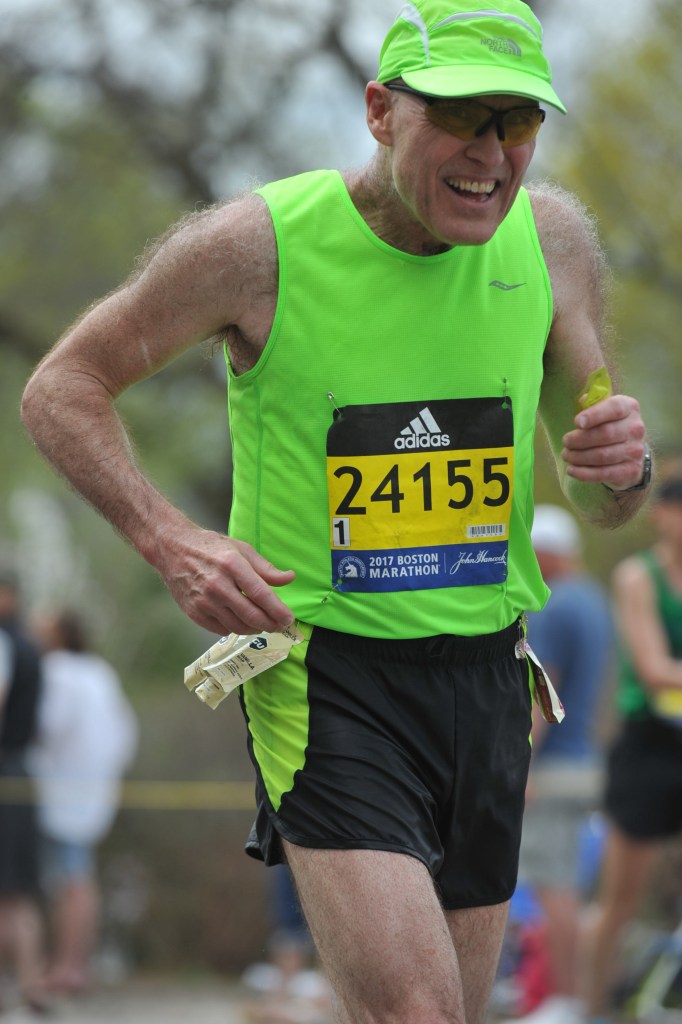
I particularly notice my posture with my shoulders hunched forward. It brings back a memory of the guidance I had received close to 45 years earlier from my first physical therapist when I was dealing with that similar knee pain he referred to as a “plica syndrome” back in my early 30’s. He told me that when people say,
“Stand up straight like a soldier standing at attention.”
This is actually not the best posture for your back. It actually puts stress on the back. One of the exercises he gave me which I used for years was what he referred to as a “pelvic tilt.” When I would do this exercise it caused me to lean forward at the shoulders taking stress off my spine which in turn relieved knee pressure. You can see me leaning forward at the shoulders in the picture.
Feeling Like a “Spring” When I Run to Keep Me Running for life
In explaining to others how I feel when I run this way I have used the analogy of a spring. I feel like the pelvic tilt gives me flexibility at both the hips and the knee which in turn reduces pounding my joints as I run. This form of running has allowed me to keep running pain free in my back and knees for over 45 years. It has helped to keep me running for life.
What I realized at that moment was that, when I was running on the treadmill for that stress test, I had gone back to the form of running that had worked for me most of my life. It is particularly effective when running up hill and when the nurse drove the elevation on the treadmill higher, I naturally went to this form with my head down, shorter stride and shoulders forward. It is what I refer to as my “running like a spring” form, with flexibility rather than pounding.
What I also realized at that moment was that I had recently started getting away from this running form that had worked so well for me over so many years. This was because I had started listening to people telling me, as I aged, that I should stand up straight rather than going around looking like an old man with a bent back.
My Chiropractor’s Feedback- Life Lesson #27: Living a resilient life is not an exact science
Later, when explaining this to my chiropractor he said, “Go ahead and use what has worked for you when you run, but when you are not running you can still work on standing up straight.”
I also gave my chiropractor a copy of the ugly x-ray report on my back. He simply replied, “This isn’t new. It might scare some people, but it doesn’t need to scare you because you have been running with this same back for 40 years. Your spine has adapted to what you want to do. I suggest you throw away that report, and just keep running.”
On May 4, I ran Bridge Run 5K in my hometown and was the first over 75 finisher in the race. I ran through pain in that knee all the way, but the pain didn’t get worse, and I knew I was ready to start building my racing miles back up in preparation for my 70th half marathon after reaching 70 years old.
May 17 – Running My 70th Half Marathon After Reaching 70 Years Old
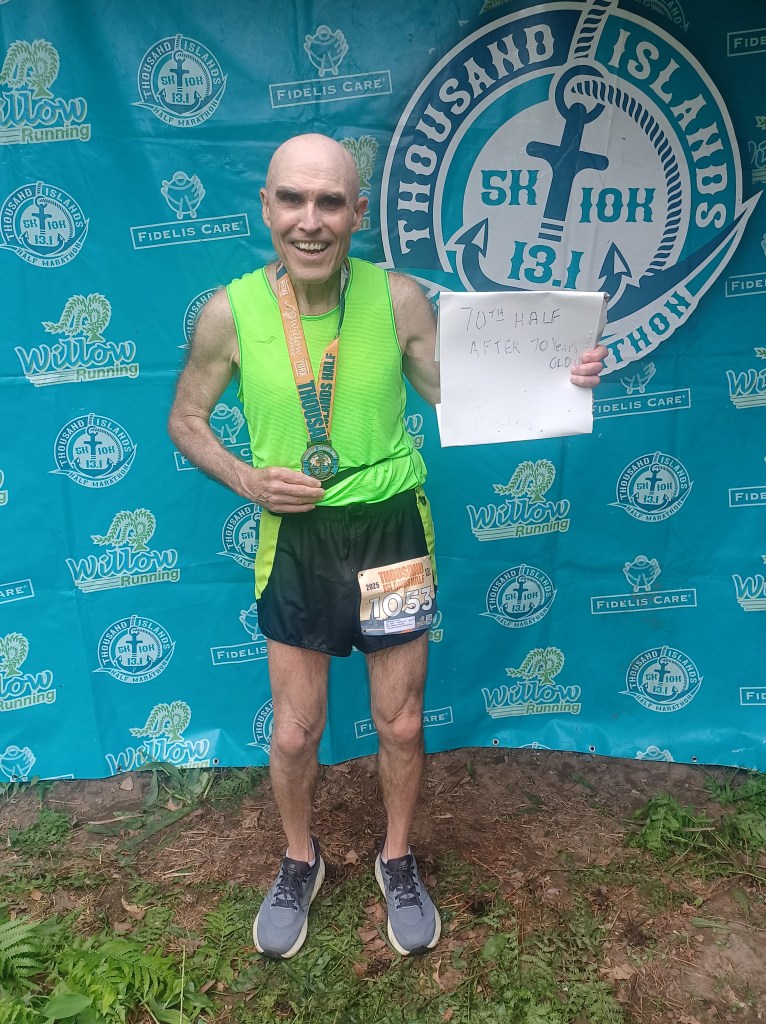
Thirteen days later on May 17 I ran my 70th half marathon after reaching 70 years old. Following is my Facebook post from after the race.
Ran the Thousand Island Half Marathon this morning on Wellsley Island in New York state. It was my 70th half marathon since turning 70 years old. This was a goal I set a few years back, and five minutes before the race was scheduled to start it didn’t look like this would be the day I would achieve this goal. The race start had to be delayed due to severe weather (downpour and lightening). But the weather eventually cleared enough to get the race in and I finished 2nd in the male 70-79 age group despite having to fight through a painful right knee from a likely pinched nerve/herniated disk. The good news is that this course has some nice hills and running up hill makes my knee feel good. When I finished the knee felt fine. I believe running 13.1 miles today has accelerated my recovery.
As a side note, two years ago in this same race my heart went into an abnormal heart rhythm at the 8 mile mark (referred to as Aflutter) and I needed a cardioversion the following week to get my heart back in normal rhythm. This now marks two full years of no Aflutter or Atrial Fibrillation(AFIB) episodes. I turned 76, 8 days ago and feel very fortunate to still be able to do this.
Conclusion
While no one wants bad things to happen in their life, for me, overcoming adversity gives me a feeling of self-worth and the motivation to keep running as long as I can.
Author’s Note
Parts of this post have been extracted and condensed with permission from my book, “Human Resilience: Keep Running Your Life” ( https://rb.gy/is0s1z ).
 Problem Solving in a Cyber World